
Every espresso workflow has a cleaning step. Whether it’s a quick knock and rinse, a dedicated brush scrub, or a fully automated cycle, what happens to the portafilter basket between shots directly shapes the quality of the next one. Yet most baristas home and professional alike have never formally compared their portafilter cleaning method against the alternatives. They’re using what they’ve always used, assuming it’s good enough.
What Manual Portafilter Cleaning Actually Involves
Manual cleaning a portafilter typically involves some combination of the following steps, depending on the workflow:
Knock box discharge: The portafilter is inverted and struck against the rubber bar to eject the spent puck. Fast, but addresses only puck removal with no cleaning effect on the basket surface.
Hot water rinse: Water is run through or over the basket to flush surface residue. Removes loose particles but cannot dissolve or dislodge emulsified coffee oils adhered to basket walls.
Manual brush scrubbing: A dedicated portafilter brush is applied to the basket interior to mechanically dislodge residue. The most effective manual method, but variable in coverage, pressure, and duration.
Backflushing: A periodic deep-clean of the group head using a blind basket and cleaning solution. Cleans the machine internals, not the portafilter basket itself.
In most setups, two or three of these steps are combined into a cleaning routine. The result is a basket that’s cleaner than an uncleaned one, but rarely as clean as it needs to be for genuine extraction consistency.
What Automatic Portafilter Cleaning Looks Like
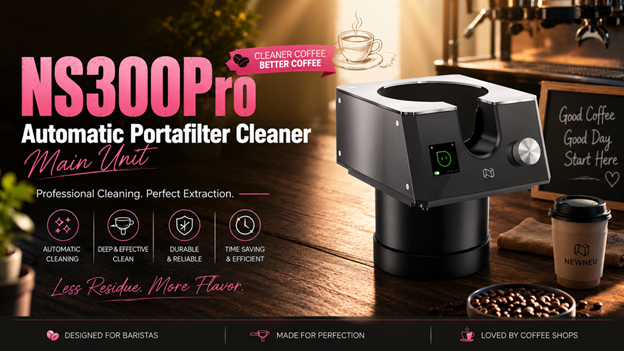
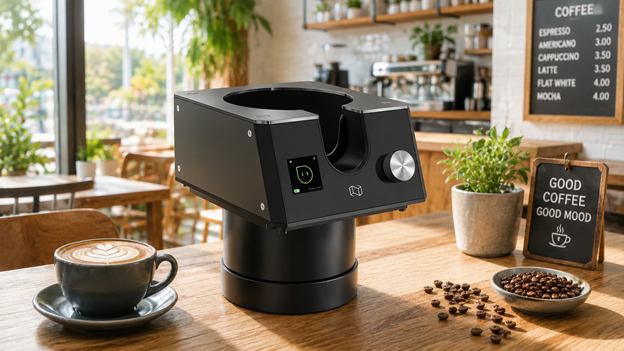
The NS300Pro Automatic Portafilter Cleaner replaces the entire manual cleaning routine with a single automated action. The barista inserts the portafilter into the cleaning head, the high-speed motor activates, and a geometry-matched precision brush head removes all puck residue from the basket interior in under three seconds. Grounds are captured in the included tabletop bucket. The basket exits clean, dry, and ready for the next dose.
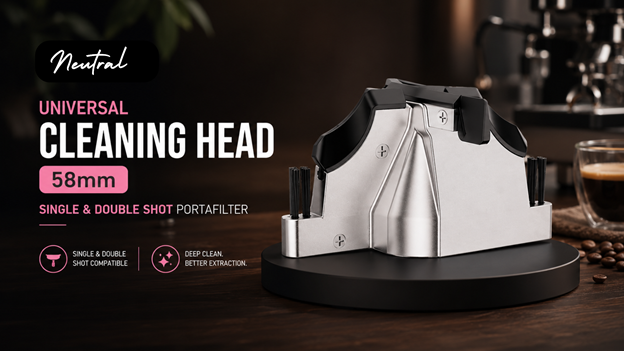
Three interchangeable soft rubber inserts (Models 01, 02, 03) cover the full range of 58mm basket geometries E61 curved, arc-bottom commercial, and flat-bottom right-angle ensuring that the automatic portafilter cleaner delivers full-contact cleaning regardless of which machine or basket is in use. No manual effort required. No variability introduced.
Head-to-Head: Manual vs Automatic Across 6 Key Dimensions
1. Cleaning Thoroughness
Manual: Variable. A manual brush covers more surface than a rinse alone, but coverage depends on technique. Generic brushes are not shaped for specific basket geometries, leaving residue in curved or angled sections. Oils on basket walls require mechanical action that most manual routines don’t consistently deliver.
Automatic (NS300Pro): Complete. The geometry-matched precision brush head makes full contact with the basket base, walls, and holes on every cycle. Oils and grounds are removed mechanically, consistently, without gaps.
2. Speed
Manual: 10–35 seconds for a combined knock-rinse-brush routine. Faster if steps are skipped but skipped steps mean incomplete espresso portafilter cleaning.
Automatic (NS300Pro): Under 3 seconds, full clean, every time. At 200 shots per day, that difference recovers nearly two hours of barista time.
3. Consistency
Manual: Inherently variable. The quality of a manual clean changes with the barista, the time of day, the pace of service, and the level of attention available. This variability feeds directly into shot-to-shot flavor inconsistency.
Automatic (NS300Pro): Identical on every cycle. Same pressure, same coverage, same result whether it’s the first shot of the day or the two hundredth.
4. Noise
Manual: The knock box impact is one of the loudest recurring sounds in a traditional café workflow. In premium environments hotel lobbies, boutique specialty cafés, office settings it degrades the customer experience with every shot.
Automatic (NS300Pro): Silent motor, zero impact noise. The entire portafilter cleaner cycle is inaudible at conversational distance.
5. Physical Impact on Baristas
Manual: 200 knock box impacts per day equals over 4,000 repetitive wrist impacts per month. Combined with the physical demands of the rest of the barista role, this is a genuine occupational health risk contributing to tendinitis and carpal tunnel syndrome.
Automatic (NS300Pro): Zero physical impact. The barista inserts the portafilter; the machine does the rest. No repetitive strain, no accumulated injury risk.
6. Long-Term Cost
Manual: Low upfront cost (knock box, brush). Hidden costs include barista time lost per shot, staff injury risk and associated downtime, and flavor consistency issues that affect customer retention. These costs are real; they’re just rarely attributed to the cleaning routine.
Automatic (NS300Pro): $360.00 upfront, complete system, 8 accessories included. Ongoing cost: replacement rubber inserts at $8.00 as needed. The electric portafilter cleaner pays for itself through recovered time, improved consistency, and reduced injury risk.
Is There Any Case for Manual Cleaning?
Manual cleaning methods retain value in specific contexts. Backflushing remains essential for group head maintenance and should be part of any espresso machine care routine regardless of whether an NS300Pro is in use. The two systems clean different things and complement each other.
For ultra-low-volume home setups pulling one or two shots daily, a careful manual brush routine is an acceptable baseline. But for anyone pulling more than 10 shots per day and certainly for any commercial operation the speed, consistency, and thoroughness gap between manual and automatic portafilter cleaning is too significant to ignore. The manual approach requires near-perfect technique every single time to approach what the NS300Pro delivers by default.
The Verdict
Across every dimension that matters thoroughness, speed, consistency, noise, physical impact, and long-term value automatic portafilter cleaning outperforms manual methods. The NS300Pro doesn’t just clean faster. It cleans better, more completely, and identically every time without the noise, the wrist strain, or the technique variability that manual methods inevitably introduce.
Manual coffee portafilter cleaning is what baristas do when they don’t have access to something better. The NS300Pro is what it looks like.
Stop cleaning manually. Start cleaning automatically.
NS300Pro Automatic Portafilter Cleaner — $360.00 (was $450), 8 accessories included, in stock.
➡ Get the NS300Pro — Better Clean, Better Coffee, Every Shot
Frequently Asked Questions
Does automatic portafilter cleaning actually improve espresso flavor?
Yes — directly. A clean basket free of oxidized oils and residual grounds eliminates the contamination that causes bitter, flat, and inconsistent shots, letting the flavor of the fresh dose come through without interference.
Is the NS300Pro compatible with my espresso machine?
Most likely yes. The NS300Pro includes three interchangeable rubber inserts covering E61, arc-bottom commercial, and flat-bottom basket profiles, making it compatible with most commercial and home 58mm espresso machines out of the box.
Can I still use backflushing alongside the NS300Pro?
Absolutely — and you should. Backflushing cleans the group head and machine internals; the NS300Pro cleans the portafilter basket. They address different parts of the espresso machine and work best used together as part of a complete maintenance routine.
How much barista time does the NS300Pro save per day?
Approximately 30–90+ minutes daily in a high-volume setting based on saving 10–35 seconds per shot compared to a manual knock-rinse-brush routine across 200 shots, time that goes directly back into service, quality, or reduced labour pressure.
Does the NS300Pro replace the knock box entirely?
Yes. The included tabletop coffee grounds bucket catches all ejected puck residue during the automated cleaning cycle, eliminating the need for a separate knock box while also eliminating the associated impact noise and wrist strain.

Leave a comment
This site is protected by hCaptcha and the hCaptcha Privacy Policy and Terms of Service apply.