
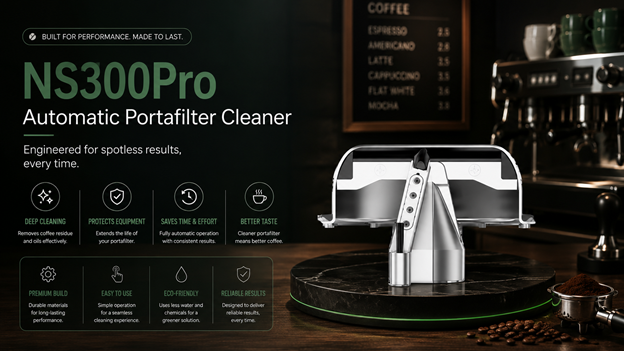
You’ve spent real money on a good espresso machine. You’ve dialed in your grind. You’ve experimented with dose and yield. You pull shots that look textbook rich crema, correct timing, proper volume. And yet something is still slightly off. The flavor is inconsistent. Some shots taste clean and bright. Others carry a faint bitterness that lingers longer than it should. The variable you haven’t tested yet is probably the one you’ve been overlooking entirely: the cleanliness of your portafilter basket before each shot.
This article walks through exactly how portafilter cleaning affects extraction what happens in a dirty basket, what changes in a clean one, and why using a geometry-matched tool like the NS300Pro Flat-Bottom Angled-Wall Rubber Insert makes a measurable difference for IMS and VST precision basket owners.
Before the Clean: What’s Actually Happening in Your Basket
After every espresso shot, three types of residue remain inside the portafilter basket: emulsified coffee oils clinging to the basket walls and base, fine ground particles embedded in and around the basket holes, and a thin film of soluble compounds dissolved from the previous puck. None of these residues are inert.
Coffee oils oxidize fast.
Within minutes of exposure to air, coffee oils undergo oxidation, the same chemical process that makes old coffee taste stale and rancid. These oxidized oils do not rinse away easily. They adhere to the basket surface and release into the next extraction, contributing harsh, bitter, and flat notes to a shot that would otherwise be clean and well-balanced. No grind adjustment eliminates this. The source of the off-flavor is the basket wall, not the fresh grounds you just dosed.
Blocked holes cause channeling.
Basket holes are precision-drilled to create uniform water distribution across the puck. When fine grounds lodge in these holes from the previous shot, that uniformity breaks down. Water under pressure finds the path of least resistance to the unblocked holes and channels through them, bypassing portions of the puck entirely. The result is a sour, underdeveloped extraction with uneven flavor compounds, regardless of how precisely you’ve set your recipe. This is why cleaning a portafilter properly between shots matters as much as any other extraction variable.
The problem compounds over time.
A single incompletely cleaned basket affects one shot. But residue that isn’t fully removed accumulates layer by layer across multiple shots, building up in the basket holes and along the walls until the contamination is significant enough to degrade every extraction. Home baristas who pull shots daily are particularly vulnerable to this slow accumulation; the degradation is gradual enough to be mistaken for seasonal coffee variation rather than a maintenance issue.
After the Clean: What Changes When Every Shot Starts Fresh
A genuinely clean basket, not just a rinsed one, but one where the oils and grounds have been mechanically removed from every surface changes the extraction dynamic in ways that are immediately noticeable in the cup.
Flavor becomes truer to the coffee.
When there’s no rancid oil residue contaminating the basket, the flavor compounds in the cup come entirely from the fresh dose. The origin characteristics of the fruit, acidity, sweetness, and body of the specific coffee are no longer muted or distorted by oxidized compounds from the previous shot. Specialty coffee that’s been carefully sourced and roasted finally has the clean extraction environment it was designed for.
Consistency becomes genuinely repeatable.
When the basket starts clean every time, the recipe variables you’ve dialed in actually control the outcome consistently. Shot-to-shot variation caused by variable residue levels disappears. The dial-in you found on Monday still holds on Friday because the baseline hasn’t drifted. This is the kind of espresso portafilter cleaning discipline that separates baristas who get lucky from baristas who are genuinely consistent.
Water flow becomes uniform again.
Clear basket holes mean water distributes evenly across the entire puck surface from the first moment of pre-infusion. The pressure builds uniformly, the puck saturates evenly, and extraction proceeds as the recipe intends without the channeling that blocked holes create. The shot runs true from start to finish.
Why IMS and VST Basket Owners Have a Specific Problem
Not every portafilter basket responds equally to the same cleaning approach. IMS Competition and VST precision baskets two of the most widely used precision basket upgrades among serious home baristas share a specific geometry: a flat bottom paired with angled, tapered inner walls. This geometry is what gives these baskets their extraction precision. It’s also what makes them harder to clean completely with a generic tool.
A flat or right-angle cleaning insert pressed into a tapered-wall basket creates gaps along the sloped surface. Residue collects most densely at the point where the angled wall meets the flat base and that’s precisely where a mismatched portafilter cleaner insert leaves the most residue behind. The basket that was upgraded for precision extraction is being undone by an imprecise clean.
The NS300Pro Flat-Bottom Angled-Wall Rubber Insert solves this by matching the slope of the tapered wall exactly. When it rotates inside the basket during the automated cleaning cycle, the angled profile presses flush against the full inner surface including the junction between the angled wall and the flat base where residue is most stubborn. It’s portafilter basket cleaning designed around the actual geometry of the basket, not an approximation of it.
Who This Upgrade Is For
The Flat-Bottom Angled-Wall Rubber Insert is the right choice if:
- You use an IMS Competition basket — B70 series, 18g–22g — standard in specialty cafés and competition setups
- You use a VST precision basket — 15g–22g — benchmark precision baskets used in serious home and professional setups
- You use a Gaggia Classic or Gaggia Classic Pro — select basket variants with a tapered inner wall geometry
- You have La Marzocco, Bezzera, or La Cimbali — with IMS-supplied or precision aftermarket baskets using this profile
- You already own the NS300Pro — and want to ensure your cleaning insert actually matches your specific basket geometry
If your basket has a flat bottom but the inner walls slope inward as they approach the base rather than sitting perfectly vertical this is the correct automatic portafilter cleaner insert for your setup. A simple way to check: hold the basket at eye level and look at the inner wall profile in good light.
Making Portafilter Cleaning Effortless Enough to Actually Do Every Time
Knowing that cleaning your portafilter matters is one thing. Doing it consistently, after every shot, without fail, is another. Manual cleaning methods create friction time, effort, variable results that makes it easy to skip under pressure or when pulling multiple shots in quick succession.
The NS300Pro automated system removes that friction entirely. With the correct rubber insert clipped onto the cleaning head, the entire coffee portafilter cleaning cycle completes in under three seconds with no manual effort. There’s no longer a reason to skip it it takes less time than pulling the next shot. At $8.00 for the angled-wall insert, it’s the lowest-cost upgrade available for baristas who want their precision baskets cleaned to the same standard they were designed to extract.
Final Thoughts: Clean the Basket, Trust the Recipe
Better espresso extraction starts before the shot. It starts with a basket that’s free of oxidized oils, clear of lodged grounds, and presenting a uniform surface for water distribution. For IMS and VST basket owners, that means using a cleaning insert shaped to actually reach the angled inner walls where residue hides, not a generic tool that leaves the most problematic area untouched.
The NS300Pro Flat-Bottom Angled-Wall Rubber Insert closes that gap. It’s a small part that solves a specific problem and for anyone who’s been chasing consistency in their espresso without being able to fully find it, the answer may be simpler than expected. Clean the basket properly, every time, and let the recipe do what it was designed to do.
NS300Pro Flat-Bottom Angled-Wall Rubber Insert — only $8.00, in stock, ships fast.
➡ Buy Now — NS300Pro Angled-Wall Rubber Insert ($8.00)

Dejar un comentario
Este sitio está protegido por hCaptcha y se aplican la Política de privacidad de hCaptcha y los Términos del servicio.